
Cloud Spend is a Capital Allocation Problem That Companies Still Prefer to Call… Almost Anything Else
For roughly the first decade and a half of enterprise cloud adoption, most organizations were evaluating their success in the cloud almost entirely through an engineering lens:
- Did our cloud migration finally finish?
- Do our developers release faster these days?
- Have our key service metrics actually improved?
Those questions absolutely still matter, but they’re no longer the questions that most boards and CFOs are asking Product and Engineering about.
Today, cloud spend is large enough to directly (and often dramatically) influence operating margin, EBITDA, and free cash flow. Which means that whatever you choose to migrate, build and continue running in the cloud has fundamentally become a capital allocation decision.
The Cloud Cost Optimization Conversation That We’re Having with Clients Has Changed
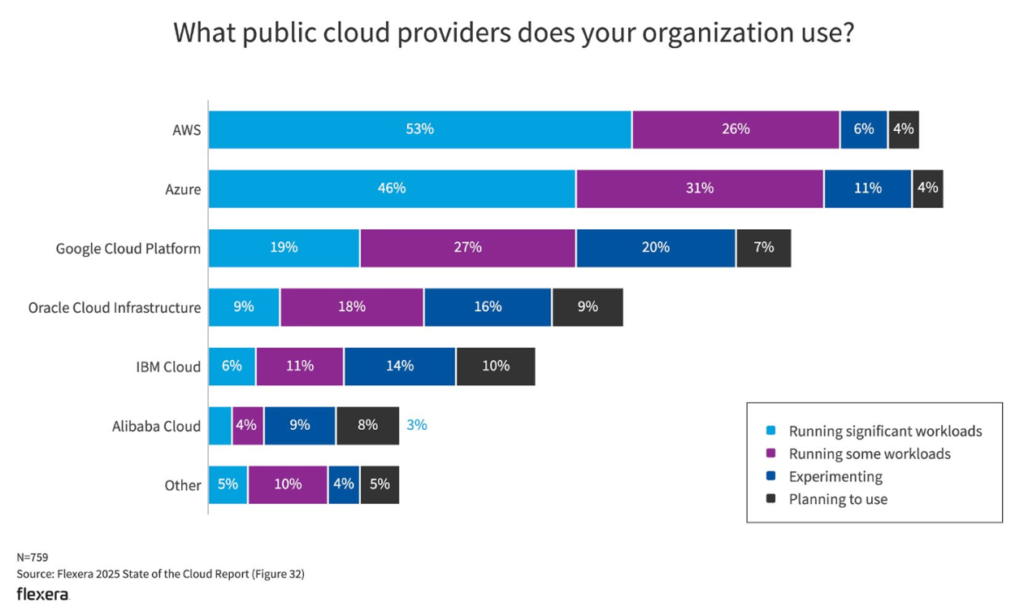
Wide industry survey data points, spanning years now, tell the story for us.
| 2022: KPMG: | “67% of 1,000 executives hadn’t achieved substantial ROI from their cloud spending, leading many to reevaluate their cloud usage to maximize value” [Link] |
| 2024: Gartner: | Cloud bills are often growing faster than top line revenues. “The majority (69%) of respondents reported budget overruns in their organization’s cloud spending.” [Link] |
| 2025: Flexera: | “Optimizing cloud cost continues to dominate” [Link] |
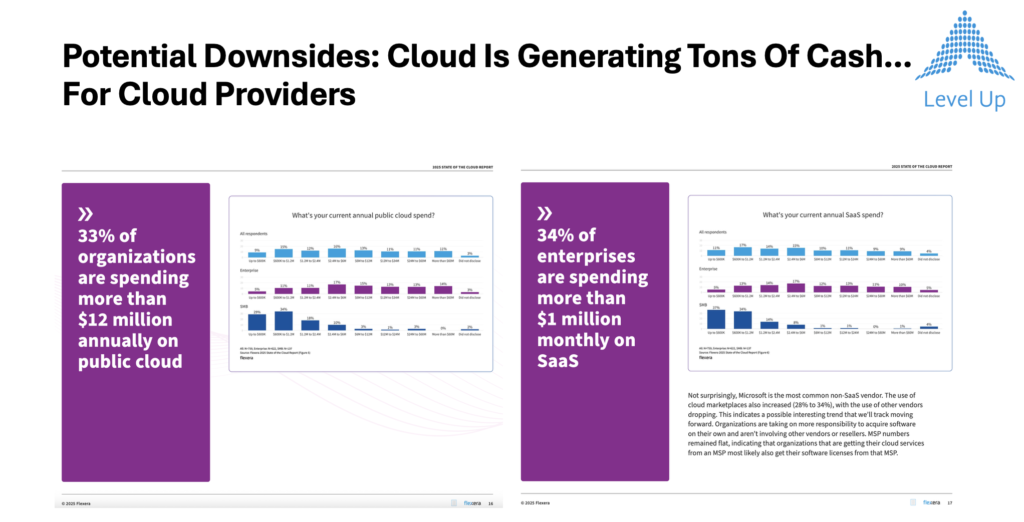
Organizations consistently report cloud spending growing faster than expected, with cost optimization now ranking among the highest cloud priorities year after year. As a result, executive committees are no longer really debating whether to use cloud, they’re simply asking if they’re truly getting sufficient business value from every dollar already being spent. That’s a completely fair question, and it deserves a complete answer.
Why Some Internal Cloud Cost Meetings End Before They Even Begin
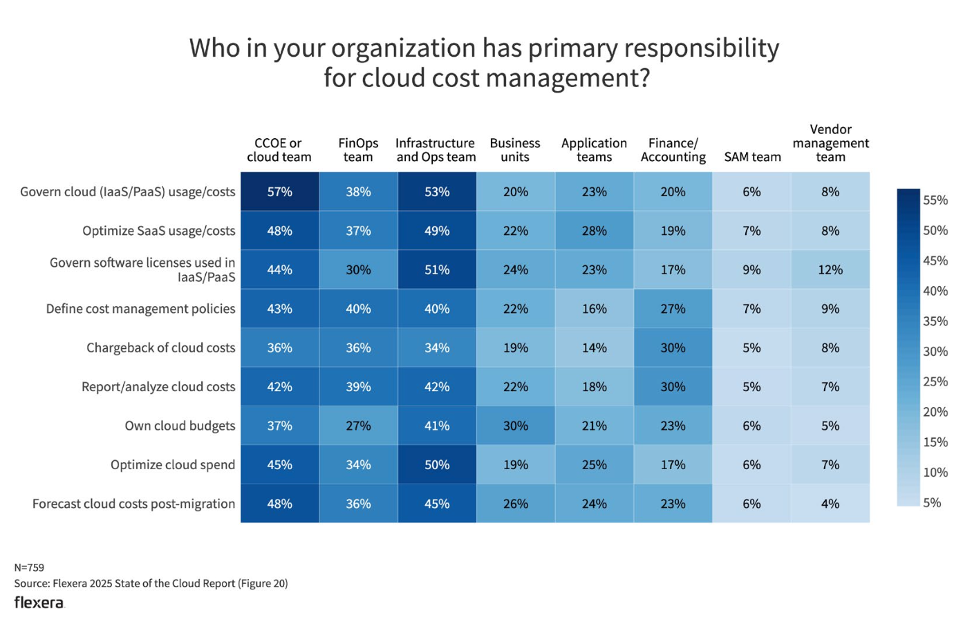
The trouble with giving those execs a complete answer about cloud spending often starts with basic incentives. Economics teaches us that personal effort tends to align with personal incentives. And especially in a business context, those incentives have a lot to do with ownership.
No matter your company’s present cash on hand situation, cash is always a relatively scarce resource. So, who owns tracking allocations of this scarce resource, which ends up being spent in complex ways that continually require leadership oversight, skilled human judgment and ideally, some type of outperforming ROI calculation? And who truly owns reducing cost if you discover you are simply spending too much on it?
| As side note: Over and over, we’ve found that CAPEX is almost always easier to talk with clients about strategically, because it is quicker for all parties to understand and then quantify an investment thesis, one which is supposed to map cleanly to current corporate objectives. But OPEX? That’s a totally different mental model and brainstorming process. This is owing primarily to the fact that while everyone may see the same overhead in the same numbers, the practical long-term business goals that that overhead is meant to be supporting might be far less clear to the various stakeholders reviewing your operational IT expenses. If you’re even reviewing them in the first place. And this is where many implicit assumptions can go unspoken and unchallenged… unless you proactively circle around to the different cost-center owners seated at the conference room table, and genuinely create space for the management-level conversation your organization’s ongoing cloud spend should be sparking now. |
Along those lines, when you look at your organization’s cloud bill from last month, do you see actual owners next to the many line items?
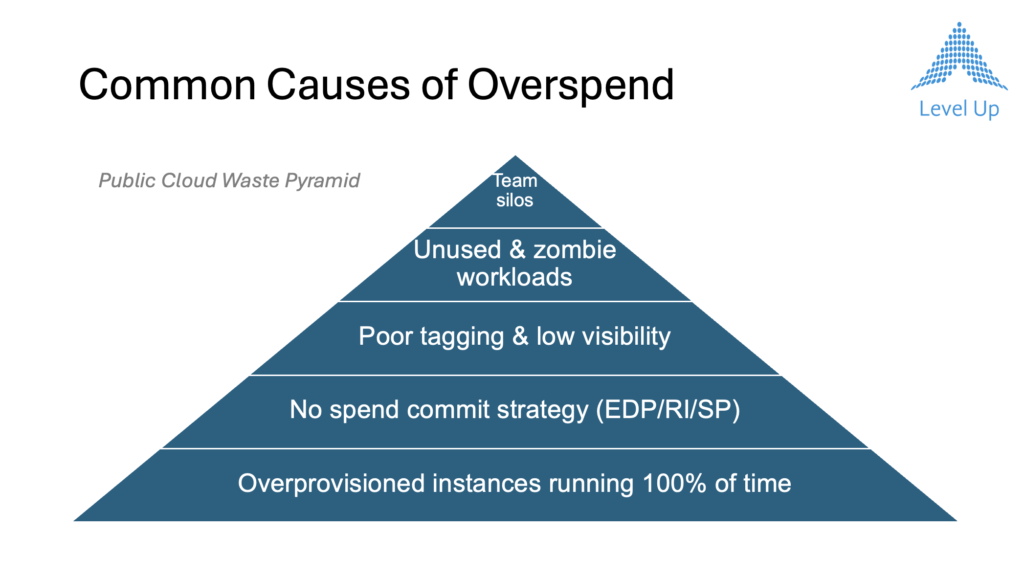
When everyone owns a piece of your cloud spend, but no one owns 100% of what goes into even a single line item, not to mention responsibility for the technical tradeoffs and business opportunity costs implied by those line items, then nobody actually owns anything. Which leads to:
- Chronically idle compute and storage resources
- Inconsistent/nonexistent team resource tagging practices
- Oversized lift-and-shift infrastructure from your datacenters
- Mismatched/underutilized Reserved Instances and Savings Plans
- Enterprise commitments that no longer reflect your current or planned usage
In Level Up’s experience, cloud cost is almost never a single team’s problem. It ends up interconnecting Engineering, Ops, Finance, Procurement, and Executive leadership. And it also becomes a hidden legacy, and a kind of organizational inheritance over the years of running in the cloud (you can call it the “that’s just the way we’ve always done things here” problem, which is almost undoubtedly playing out across hundreds, thousands, or tens of thousands of overbuilt compute instances in your own environment as you read this).
Treating Your Cloud Like an Investment Portfolio
The organizations that Level Up sees getting the best results don’t simply cut costs, they manage their cloud like an investment portfolio.
If you ask us, every cloud workload analysis should answer five questions for you (all of which should be able to tell you if this is an optimal, ongoing expenditure still worth investing into the business objectives it is supporting today):
- Are you measuring cloud workload utilization?
- Is that cloud workload utilization appropriately deployed?
- Can your ongoing cloud workload analysis largely be automated?
- Which team is accountable for governing what gets spent on cloud workloads?
- Whose chargeback/showback report does each cloud workload ultimately belong to?
And that’s why Level Up’s cloud cost engagements follow these four phases:
Assess → Optimize → Automate → Govern.
Which means that classic low-hanging fruit like “rightsizing your infrastructure” is usually just a starting point, but never the end goal. Commitment strategy, automation, tagging, forecasting, and executive reporting are equally important, because those are some of the biggest key drivers of cloud capital efficiency across the entire business.
Conclusion
If Finance can’t confidently forecast a cloud bill, and if Engineering can’t explain why it’s constantly changing, you were never dealing with an infrastructure issue. You’ve actually been dealing with a capital allocation problem. And the first step to solving any problem is naming it.
As far as the step that follows that one? Level Up’s fixed-fee Cloud Economics Assessment helps you identifies any overspend, evaluate your commitment strategy, and deliver an executive roadmap for measurable savings. Reach out today to start the conversation: info@levelupla.io.